How to Feed Multiple Cats Separately
Putting two bowls on the floor sounds like separate feeding. We gave Erbing and Qitiao a bowl each, side by side. But after eating her own food, Qitiao would put her head into Erbing's bowl while Erbing was still eating. Erbing usually stepped aside rather than competing for it.
Two bowls alone did not create two protected feeding spaces in our home. Closing a door helped keep Qitiao away during a meal—but it left another question unanswered: what happened to Erbing's food when she paused and wanted to come back?
Separate feeding is about access over time, not just separate bowls at mealtime. Here's how to plan for both.
Quick Answer
To feed multiple cats separately:
- Give each cat her own accessible feeding station.
- Put meaningful distance between stations; add visual separation or use different rooms when needed.
- Watch what happens after the faster cat finishes—not just when the meal starts.
- If one cat grazes, arrange protected access to her leftovers or a later feeding opportunity.
- Adjust the arrangement if a cat keeps getting distracted, appears tense or isn't eating normally.
Start with the simplest arrangement you can manage. There is no single feeding schedule for every cat; ask your veterinarian about suitable intake, special diets and health concerns. These steps combine FelineVMA's separate-station guidance with the access problem we encountered at home.
What Separate Feeding Did—and Didn't—Do in Our Home
Two bowls, but still one accessible food area
Erbing is our slow eater. She prefers a little food at a time. Qitiao eats faster, and having an assigned bowl didn't stop her from moving straight to Erbing's.
Erbing usually gave way: she would stop eating or move away instead of trying to hold her place. This wasn't only a kitten-stage habit. Even now, if food has been low for a while and both cats are hungry, a refill can bring back the same pattern.
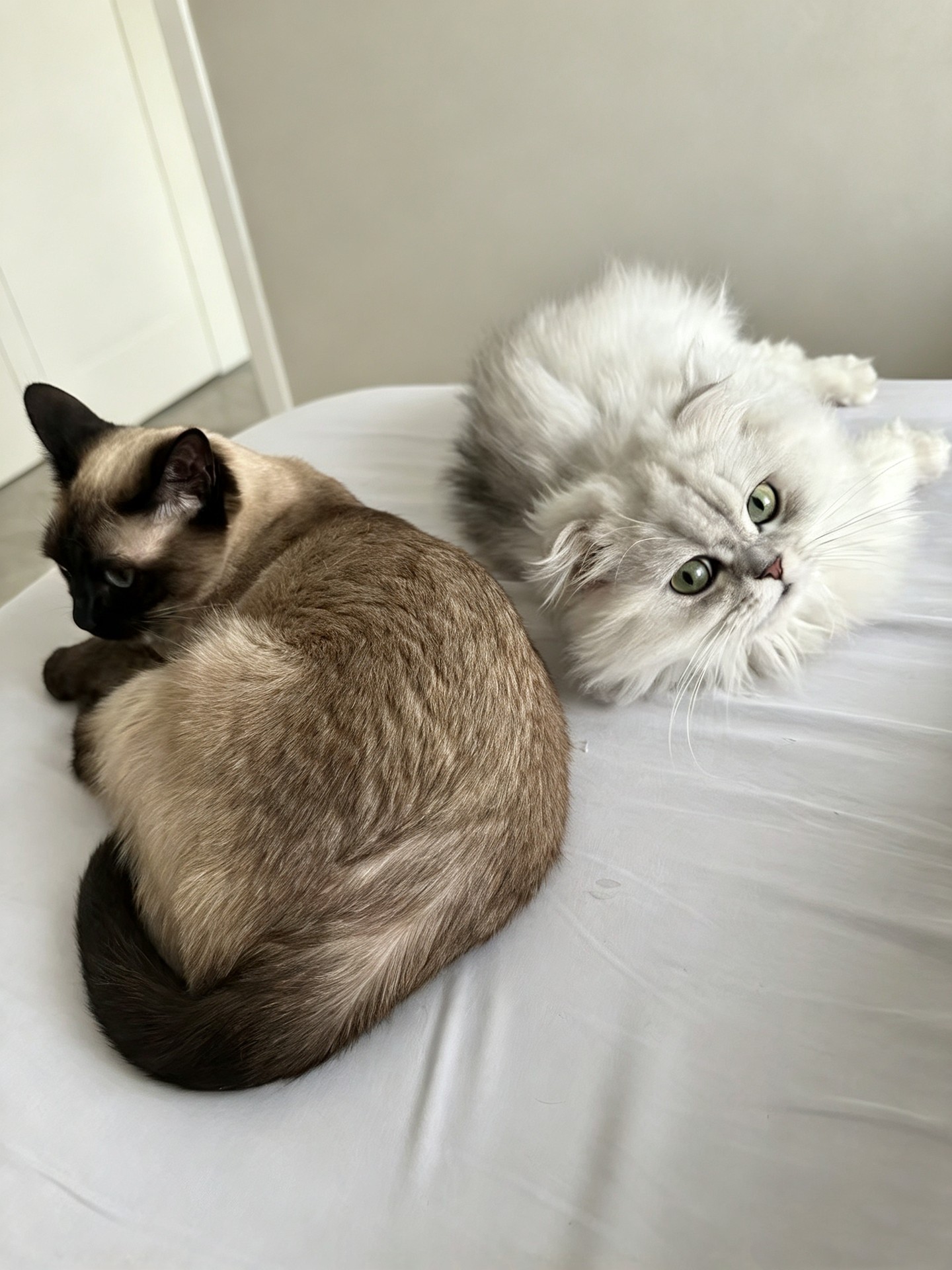
Erbing (left) tends to eat slowly and give way, while Qitiao (right) is the more food-motivated of the two.
A closed door protected the bowl, but changed the meal
We tried putting Qitiao in another room so Erbing could eat alone. Qitiao kept scratching at the door until we opened it.
Erbing is cautious and sensitive to sound. At home, an unusual noise usually gets her attention immediately; sometimes it sends her away. With Qitiao scratching nearby, she kept looking toward the door instead of settling into her food. The noise and movement interrupted her eating.
She still ate only part of the food. We didn't have a fixed separation time—we generally let Qitiao out when Erbing stopped eating. That put Erbing's leftovers back within Qitiao's reach.
Looking back, we were trying to solve two problems:
- During the meal: Could Qitiao reach Erbing's bowl while Erbing was eating?
- After a pause: Could Qitiao reach the food Erbing wanted to return to later?
The door physically protected the first eating session. It didn't protect the next visit, and the scratching made that first session less comfortable for Erbing.
Why the twice-daily routine didn't fit
Our scheduled meals were around 7:00 in the morning and 18:00 in the evening. Before work, feeding meant waiting for Erbing, releasing Qitiao and clearing the bowls. Erbing often ate only a little at breakfast, and sometimes she needed another meal before bedtime.
We stopped that approach because it added complexity without adequately resolving access. Scheduled feeding didn't fit our household or Erbing's eating pattern; that isn't a verdict on scheduled meals for other cats.
What happens in our household now
For everyday food, the cats currently share one bowl. We top it up manually when food runs low, and they can go back to it when hungry. Obvious food stealing is less prominent than before, but we can't accurately tell how much each cat eats in a day or independently control their intake. This is our current routine, not our recommended separate-feeding solution.
Small portions are different. For treats or canned food, we still put their containers in different areas. Otherwise, Qitiao keeps eating until all the food is gone, leaving none for Erbing.
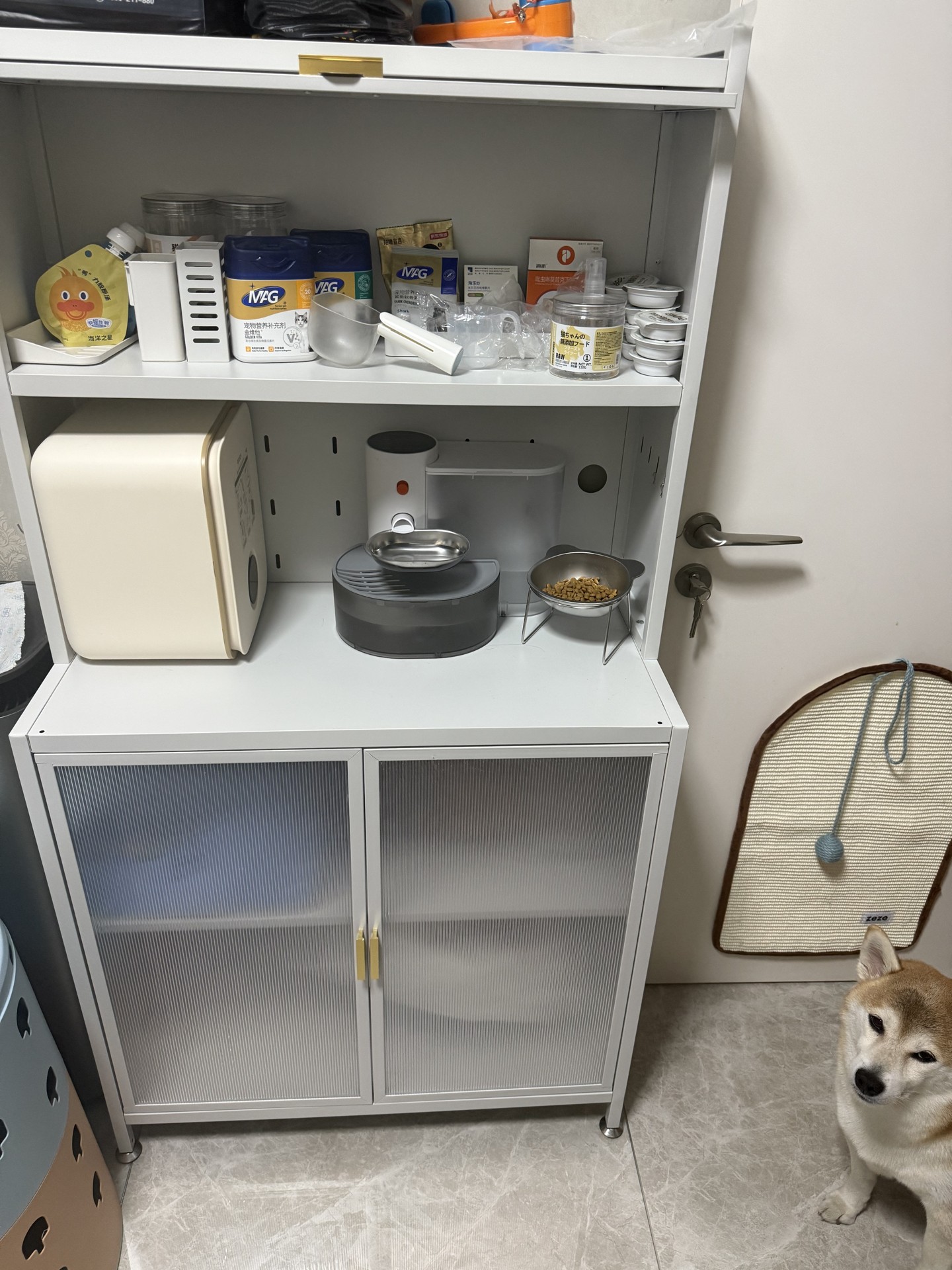
Our cats' current everyday feeding area. This is what we use at home now, not a separate-feeding setup we recommend for every household.
For the wider story of our feeding attempts, see How to Stop One Cat From Eating Another Cat's Food.
Start With the Simplest Setup That Works
Use this ladder to plan how much separation you need. It is an order for trying manageable changes, not a requirement to work through every level or buy equipment.
| Level | Setup | What to check |
|---|---|---|
| 1 | Separate bowls with meaningful distance | Does each cat get to eat before the other approaches? |
| 2 | Different parts of the room with visual separation | Can either cat still walk over and take the other's food? |
| 3 | Separate rooms during meals | Does each cat eat comfortably, and is the routine practical? |
| 4 | Supervised, protected return access for a grazer | Who can reach leftovers between visits? |
| 5 | Research individual-access options when supervision is impractical | Does a specific device address the access problem you actually have? |
Try the lowest-cost, least disruptive change that fits the problem. If the meal is protected but later visits aren't, focus on return access rather than simply adding more bowls.
A Practical Separate-Feeding Routine
The routine below is planning guidance, not a claim that we successfully tested each arrangement.
1. Pick a station for each cat
Choose places each cat can comfortably reach and already uses. FelineVMA recommends distance, visual separation and bowls away from litter boxes. Different areas of the home are also an option in Cornell's feeding guidance.
Before serving food, look at the route between the stations. A visual barrier blocks the view, but it doesn't reserve the bowl. If the faster eater can walk around it, you'll still need to supervise access or use a different arrangement.
2. Watch the end of the faster cat's meal
Put each cat at her station, then stay for the part that's easy to miss: one cat finishes while the other is still eating. Watch whether the faster eater approaches the second bowl and whether the slower cat continues eating or moves away.
If you're feeding cats in separate rooms, pay attention to both the physical separation and the sounds around them. Our closed door kept Qitiao out, but her scratching still interrupted Erbing. Change the arrangement if it isn't allowing normal eating; persistent feeding difficulties are a reason to ask your veterinarian for help.
3. Make a plan before reopening access
A slow-eating cat may stop before her food is gone. Before opening a door or ending supervision, decide:
- Who can reach the remaining food?
- When will the slower cat have another chance to eat?
- How will you protect that later opportunity?
- Who can supervise it during your normal day?
For us, releasing Qitiao when Erbing stopped eating reopened access to the leftovers. The missing step was a plan for Erbing's return.
Avoid building the routine around a universal timer or making a cat finish a bowl. Feeding frequency depends on age, health and preferences; Cornell recommends a routine that works for the cat and the household. Ask your veterinarian how to arrange suitable feeding opportunities if a grazer's later visits are difficult to protect.
Which Setup Fits Your Household?
| Situation | Start with | Main limitation |
|---|---|---|
| Both cats finish meals | Separate feeding stations | The faster cat may visit the other bowl |
| One cat eats much faster | Distance plus supervision | Someone needs to monitor access |
| One cat grazes | Protected return access | Harder to maintain throughout the day |
| Cats need different diets | A plan that controls access to each food | Requires stricter separation and veterinary diet guidance |
| You can't supervise later meals | Research individual-access options | May require equipment and a model-specific assessment |
Use the row that matches your access problem, rather than assuming every multi-cat home needs the same setup.
When Individual Access Becomes Worth Researching
If food needs to stay available, the cats share a space and you can't supervise later meals, individual access becomes the question to investigate.
Some microchip feeding bowls restrict access to a particular cat, as described in FelineVMA's guidance. That is different from deciding where the bowls go or when you supervise a meal.
We haven't tested microchip or RFID feeders. Check a specific model's instructions and suitability before relying on it; we aren't recommending a model here.
How Microchip Feeders Differ From Automatic Feeders is a planned cluster topic for that comparison. It has not been selected as our next article.
What to Monitor
Note which cat reaches each bowl, what remains and whether the slower eater returns. Ask your veterinarian about appropriate daily intake, and monitor weight and body condition, as FelineVMA advises. An empty shared bowl doesn't tell us how much each of our cats ate.
If you also want to know how much each cat is actually eating, see our guide to monitoring each cat’s food intake in a multi-cat home.
If a cat stops eating, contact your veterinarian promptly rather than continuing to change the feeding setup. Cornell's guidance on appetite loss explains why this needs attention.
Our Takeaway
We thought about protecting Erbing's meal, but not enough about protecting her next visit to the food. The door stopped Qitiao reaching the bowl while it was closed; opening it brought back the access problem.
When you plan separate feeding, start with two questions: Can each cat eat now? Can each cat still get to her own food later? The second question matters especially when one cat grazes.
FAQ
Should each cat have her own food bowl?
Separate bowls in separate locations can be a useful starting point, as FelineVMA recommends, but they don't by themselves protect access during the meal or afterward. That makes it easier to watch who reaches each bowl, though it only helps you track individual intake if each cat stays with her own food. In our home, side-by-side bowls let Qitiao move to Erbing's while Erbing gave way.
Can I feed two cats separately in the same room?
Start with distance and visual separation, then watch what happens when one finishes. If that cat can still reach the other's food, change the placement or use more supervision or physical separation.
How long should I keep cats separated for feeding?
There isn't a universal timer we can recommend. In our trial, we released Qitiao when Erbing stopped eating, which exposed the leftovers again. Plan the next feeding opportunity as well as the current session, with veterinary advice when needed.
What if one cat grazes?
Protect later visits to the food. That might mean supervised return opportunities; if you can't maintain those, research individual-access options. A closed door at one meal doesn't protect food after that door opens.
Does separate feeding mean different food?
No. Location and access are separate questions from diet. If your cats require different foods or a prescribed diet, follow your veterinarian's feeding plan and control who reaches each bowl.