How to Monitor Each Cat’s Food Intake in a Multi-Cat Home
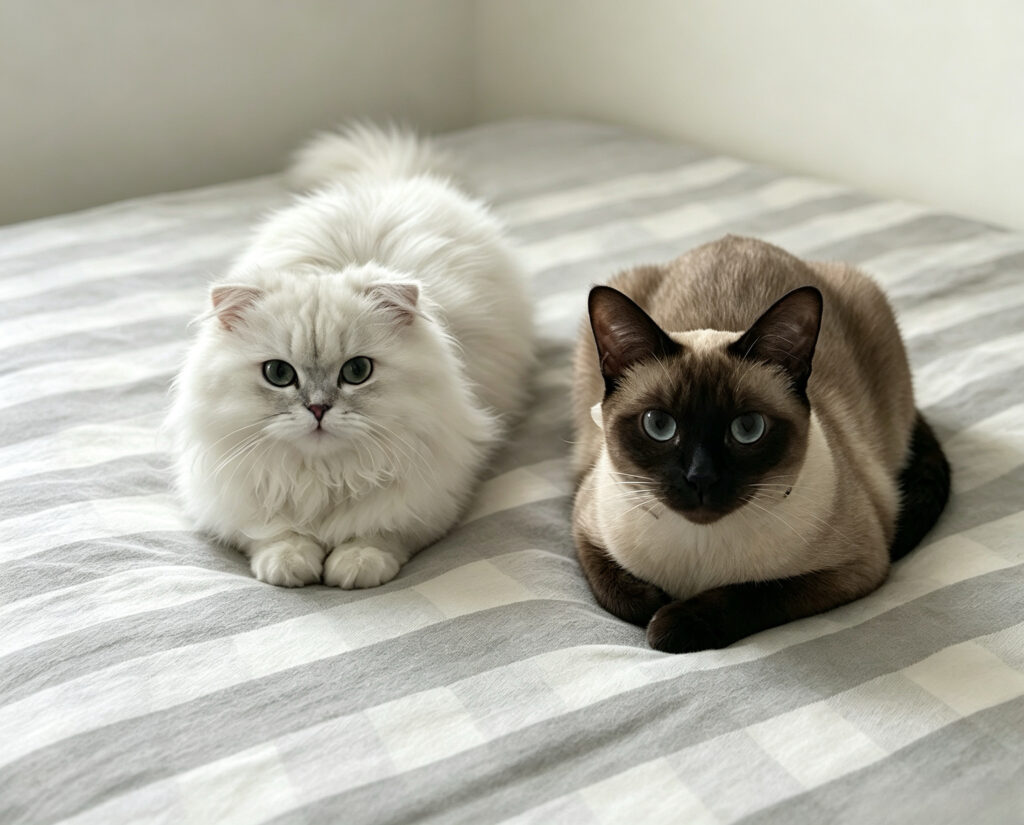
An empty food bowl looks like an answer: the cats ate. In our home, it leaves a more useful question unanswered—which cat ate, and how much?
Erbing eats slowly and prefers small amounts. Qitiao has eaten much faster than her. We now use a shared bowl and add food by hand, but I cannot accurately tell how much each cat eats from that setup.
One evening after work, Erbing kept meowing and rubbing against me, then led me to the food bowl. It was empty. I added food, and she started eating. I suspected Qitiao had eaten more of the earlier food, but I hadn’t actually seen what happened.
What I knew was that the bowl was empty and Erbing ate after I refilled it. I did not know how the earlier food had been shared. That distinction is the starting point for this guide: knowing how much food disappeared from a shared feeding setup is not the same as knowing how much each cat actually ate.
Quick answer
To monitor food intake in a multi-cat home, start with who you actually see eating. For dry food, weigh what goes into the bowl and what remains, recording refills and any known spills or removals. Keep those amounts separate from guesses about which cat ate them. Add a short note about appetite and behavior, and leave an individual amount unknown when you cannot account for it.
If a cat stops eating or has a worrying change in appetite or behavior, contact your veterinarian promptly. Do not wait for a complete food log before asking for help.
The steps below combine the problems we’ve encountered with published feeding guidance. They are a practical way I would approach monitoring now, rather than a complete system we’ve tested over time. Our shared bowl is household context, not a recommendation for every home.
1. Start by noticing who actually eats
For an ordinary feeding observation, choose a time when you can be nearby. Write down the cat you see eating and whether another pet reaches the food. A glimpse of a cat near the bowl tells you less than watching her eat; neither observation, on its own, gives you a weight of food swallowed.
A note such as ‘Saw Erbing eating after the refill’ records an observation. ‘Erbing ate her full share’ adds something you may not know. Let the note stop where your observation stops.
If your cat eats a little and returns later, keep that return in mind. Erbing’s preference for small amounts is one reason I would not judge her whole day’s eating from one brief visit to the bowl. Let the record follow the cat’s routine instead of treating a short meal as the whole picture.
2. Work out whether the food can be linked to one cat
Before putting an amount beside a cat’s name, ask whether anyone else could have eaten from the food—including while you were away. A named bowl alone does not establish exclusive access.
A useful starting point is a feeding opportunity where you can tell which cat has access and observe her eating. If both cats can return to the same bowl outside your observation, keep the bowl’s total separate from their individual notes. ‘Shared bowl; individual amounts unknown’ is an honest result.
If shared access is making that difficult, our guide to feeding multiple cats separately explains practical ways to create clearer feeding boundaries before trying to track individual intake.
Do not divide a shared total equally just because there are two cats. The arithmetic would give you an average, not evidence that either cat ate that amount. If food swapping is the problem you need to address first, our guide to How to Stop One Cat From Eating Another Cat’s Food covers that part of the problem.
Keep feeding comfortable and make sure each cat can reach her food. Do not create a long gap without food or insist that a grazer finish immediately just to make the numbers easier. Ask your veterinarian for help if monitoring requires a change to a cat’s feeding plan.
3. Measure dry food offered and left over
I used an electronic scale to weigh food before putting it out during an earlier feeding routine. But I did not weigh or record the leftovers. Knowing the amount offered was only part of the information I needed.
AAHA’s nutrition guidance recommends a gram scale for more precise food portions than measuring cups. The AAFP feeding consensus also discusses measuring food when filling a station and measuring what remains later. These are useful starting points for weighing food, while the shared-access question still needs its own answer.
Choose a clear start and end time for your dry-food record. Use the same units, and exclude the bowl’s weight—for example, with the scale’s tare function. Note starting food, refills, food left at the end, and anything removed uneaten.
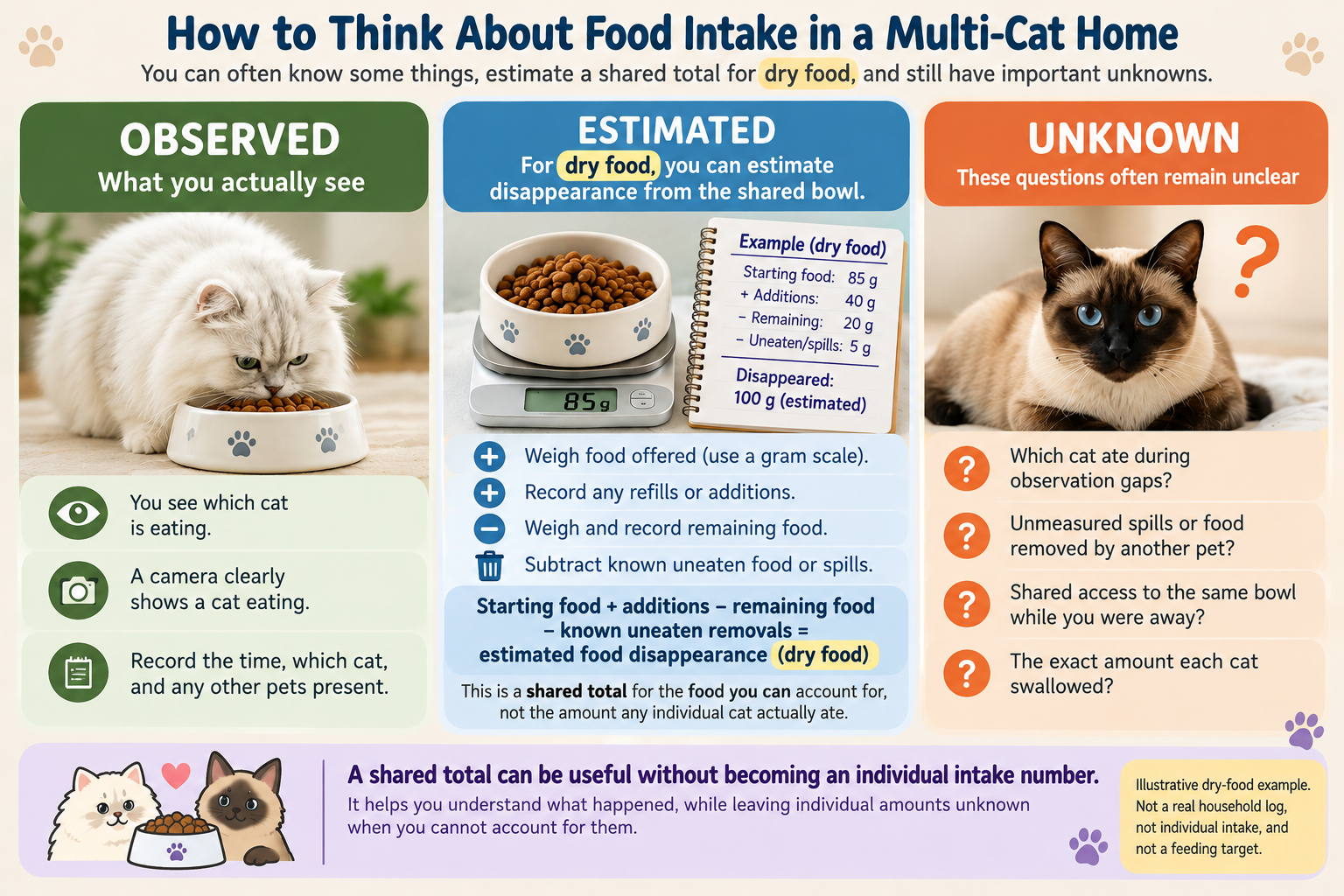
You are estimating how much dry food disappeared from the food you could account for—not directly measuring how much a particular cat swallowed:
Starting food + additions − remaining food − known uneaten removals = estimated food disappearance.
Count discarded food or recovered spills as known uneaten removals, once only. If you cannot measure a spill, note it as unmeasured.
Unnoticed spills, another pet’s access, observation gaps, and measurement error keep this from being exact intake. A shared bowl’s estimate remains shared unless you can attribute it to one cat.
Our dog, Liuyi, occasionally eats a little cat food that has fallen on the floor, even though we keep the cat food where he usually cannot reach it. That is a small household reminder to account for food outside the bowl, without assuming the dog has eaten from the bowl itself.
Keep this approach to dry food here; do not apply the same calculation to wet-food weight changes and call it intake. Record wet food and treats separately as food offered and any eating you actually observed. A gram amount in this log is a record, not a suggested daily feeding amount.
4. Keep a short log you can actually maintain
Use a notebook or phone note for the feeding period you can account for. Keep it short enough to maintain.
This original MultiPetLife practical monitoring log is organized from our research. It is not a veterinary medical record or a long-term system we have validated at home.
| Field | What to write |
|---|---|
| Date / time | When the observation started and ended |
| Cat | The cat being monitored, or ‘shared bowl’ |
| Food offered | Food type and amount put out, if measured |
| Food remaining | What was left at the end, if measured |
| Added / removed / spilled | Refills and food that left the bowl uneaten; note unmeasured spills |
| Who was actually seen eating | Name the observed cat; leave unobserved access unknown |
| Evidence source | Watched directly, camera review, or App record |
| Appetite / behavior note | What was different or worth mentioning |
| Confidence | Observed, Estimated, or Unknown—for the particular entry |
Label each part separately: you may have Observed a cat eating and Estimated food disappearance, while her individual intake remains Unknown because another cat had access.
Include other food offered during the same period, such as treats or canned food, so the dry-food note does not look like the entire diet. The WSAVA diet-history resource asks about food amounts, frequency, measuring methods, and extra foods. Our shorter log uses that general lesson without copying the form.
Ask anyone who refills the bowl to leave a note. An unmeasured refill stays ‘amount unknown’; it does not belong in a fully measured total.
5. Use App and camera information for what it shows
Our feeder App gave us a total, not an answer for each cat
We previously used an automatic feeder with weighing and recording information. I checked its App totals and changes, but the records could not distinguish how much Erbing and Qitiao each ate. A total for both cats did not become a separate amount for either one.
If you already use a feeder App, check what its number describes before adding it to your log. Is it food dispensed, a change in bowl weight, a shared total, or a device’s estimate? Those are different kinds of information. If the meaning is unclear, keep it as an App record rather than relabeling it ‘food eaten.’
Our independent camera helped with visits, not grams
I have used an independent camera to look back at the cat-food area when the food seemed to have gone down unusually little or a cat’s behavior worried me. Reviewing it helped me see visits to the food, but it was still difficult to judge how much was eaten on each visit.
For your own camera notes, write down the cat you can identify and what the recording actually shows. If it shows a visit but does not clearly show eating, say ‘visit.’ If the view or recording leaves a gap, keep that gap visible in the note. Visit counts should not be converted into grams.
I have not tested microchip/RFID feeding or a feeder with a built-in camera. These remain categories for further research, not equipment recommendations from our experience. For any future device, the useful question would be what evidence it adds about access, identity, and amount—and what still remains unclear.
6. Watch the cat, not only the bowl
On another occasion, I noticed a marked change in Erbing’s eating and everyday behavior and promptly sought veterinary help. That experience is why I would not let a food total replace looking at the cat herself.
Note changes plainly—‘ate less than I usually see’ or ‘less interested in interacting’—without naming a cause. Share what you have with your veterinarian; the record need not be perfect.
We have had the cats weighed at the veterinary clinic, and I watch weight changes at home when concerned. I have not noticed an obvious overall change in weight or shape, but that tells me neither cat’s daily intake, nor whether they ate equal amounts.
FelineVMA advises monitoring weight and body condition and seeking veterinary help with concerns about over- or undereating. Ask your veterinarian about your cat’s feeding amount and follow-up.
If a cat is not eating, contact your veterinarian immediately, as Cornell’s Feline Health Center advises. Seek advice promptly about worrying appetite or behavior changes; do not wait to complete a food log.
Common questions about monitoring several cats
Can I divide the amount eaten from a shared bowl between my cats?
No. Equal division gives an average, not each cat’s intake. Keep the shared total separate and leave individual amounts unknown when you cannot attribute them.
Does seeing a cat at the bowl mean she ate enough?
A visit is not an amount eaten. Even seeing her eat does not establish that she met her needs. Ask your veterinarian if you are concerned.
What if I cannot watch every feeding visit?
Record what you can see and leave the gaps visible. Use camera or App information within its limits rather than assigning an unsupported individual amount.
What is the most useful first step?
At the next ordinary feeding opportunity, note who you see eating, food offered, and any appetite or behavior change. Add weighing and a short log where they fit your routine.
Final takeaway
You do not need a perfect spreadsheet to begin getting a clearer picture. Start with the cat you actually saw eating, keep measured amounts separate from estimates, and let an unknown stay unknown. A shared total can be useful without becoming an individual intake number. Add observations as your routine allows, while continuing to notice the cat’s appetite and everyday behavior. The goal is better information you can use and share with your veterinarian—not a number that only looks precise. If something worries you, ask for help before finishing the log.