Free Feeding vs Scheduled Meals in a Multi-Cat Home
Quick answer: choose a routine, not a winner
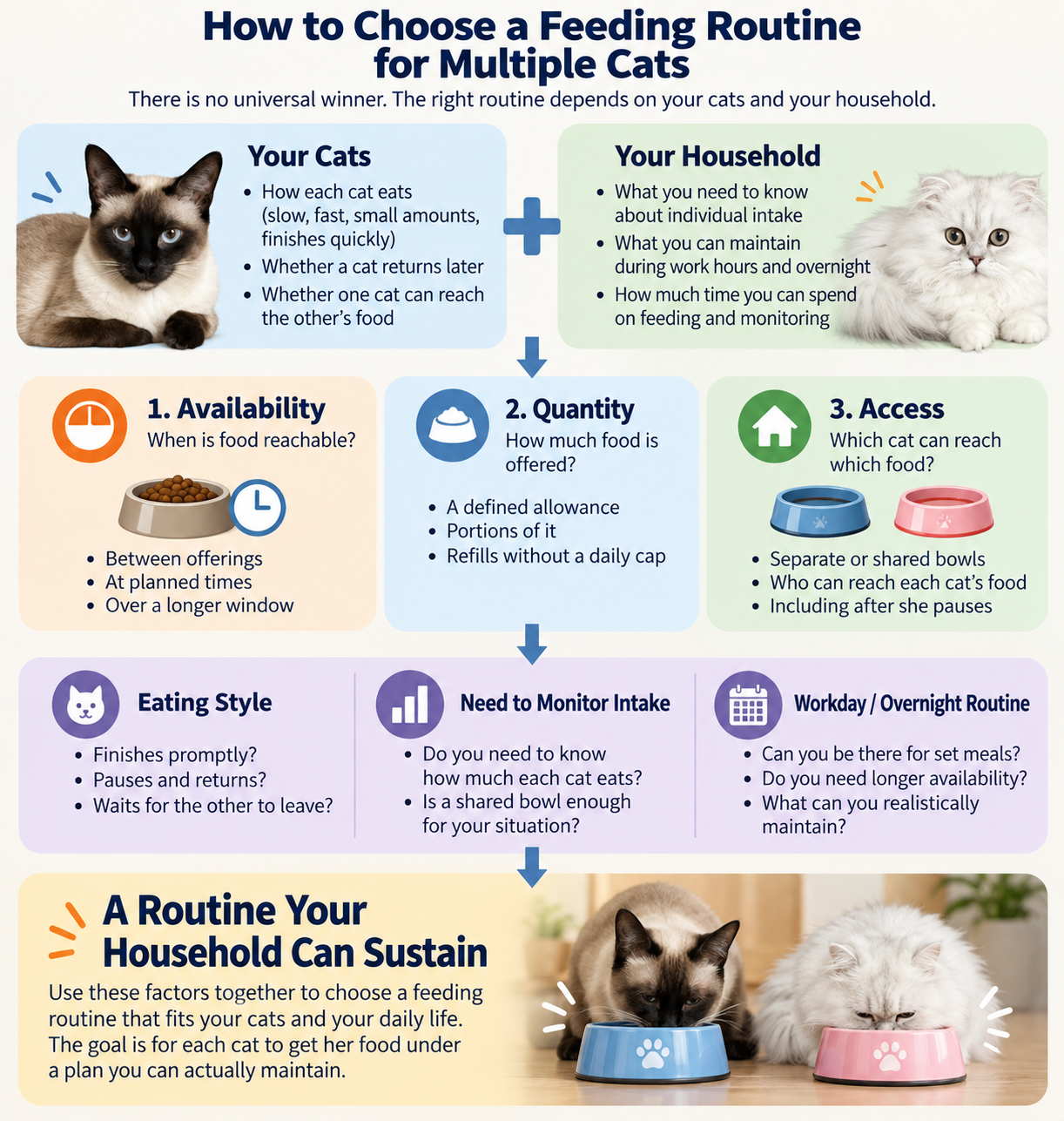
There is no universal winner between free feeding and scheduled feeding in a multi-cat home. Start with how each cat eats, whether she can reach the other cat’s food, what you need to know about individual intake, and what you can maintain during work hours and overnight.
Food left available may accommodate a cat who eats a little and returns later, but you still need a plan for quantity and access. Planned meals can organize when you offer food, yet a timetable alone does not protect a slower cat’s leftovers. You can also plan replenishment times while allowing longer access. The useful question is: Can each cat get her food under a routine the household can actually sustain?
Separate availability, quantity, and access
“Free feeding” and “scheduled meals” can describe different arrangements. Before choosing a label, ask three questions:
| Dimension | Question to answer | What to specify in your plan |
|---|---|---|
| Availability | When is food reachable? | Between offerings, at planned times, or over a longer window. |
| Quantity | How much food is offered? | A defined allowance, portions of it, or refills without a daily cap. |
| Access | Which cat can reach which food? | Who can reach each cat’s food, including after she pauses. |
These decisions are connected, but changing one does not automatically change the others. Food left available may still be limited in amount. A set serving time does not tell you when food is removed—or who eats it.
This distinction has a veterinary basis: the AAHA Nutritional Assessment Guidelines discuss measured amounts with both free-choice and meal feeding. Quantity control is not exclusive to short meal windows.
You can limit the amount supplied while leaving food available, or offer it at planned times and decide whether leftovers stay out. Repeated offerings can use portions from the same daily allowance.
A “hybrid” or combined routine simply mixes parts of those arrangements. Here it is a convenient description, not a standardized veterinary category.
When you encounter “free-choice” or “ad libitum” in guidance, check the source’s description of quantity and availability. Do not assume every use of “free feeding” means unlimited refilling, or that every timed routine means only one or two brief chances to eat.
Why different eating styles change the decision
The difficulty often appears after the first cat finishes. If one cat leaves food and returns later, the plan needs to allow for that return. Moving the feeding time earlier or later does not settle who can reach the leftovers.
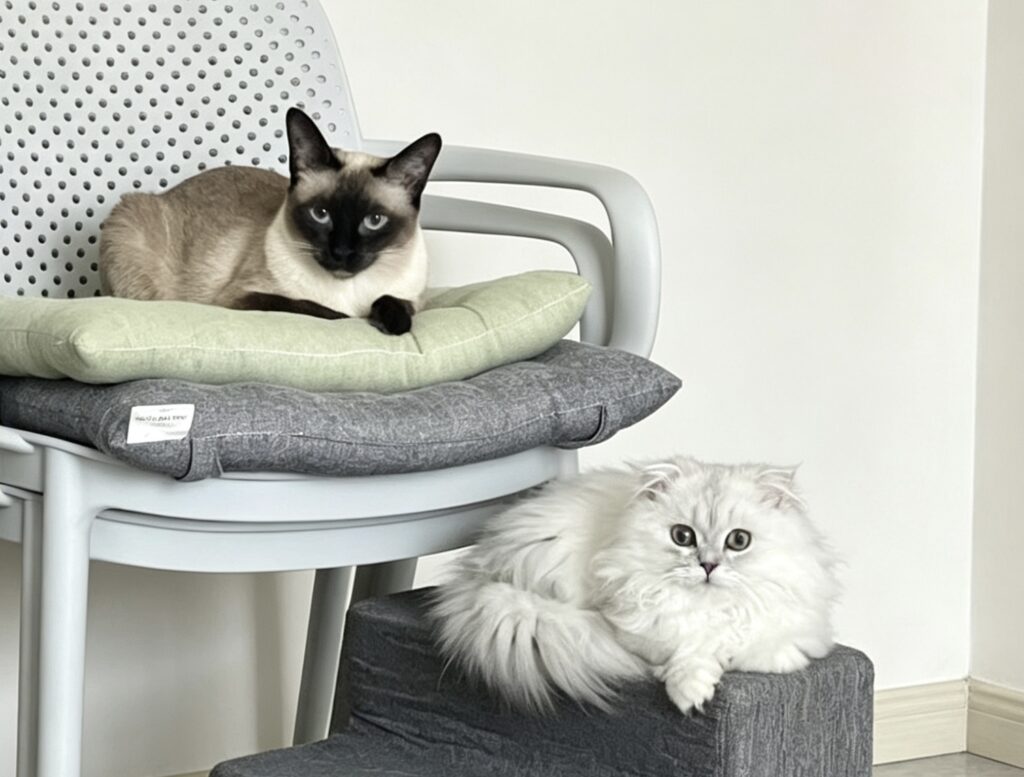
In our home, Erbing eats slowly, prefers small amounts, and may step back when Qitiao approaches. Qitiao eats faster and often eats first when food is replenished. During an earlier morning-and-evening routine, leftovers stayed available between those occasions, and Erbing returned during the day. Remaining food was replaced when the next feeding occasion required fresh food. Those were planned replenishment times, not strict short meal windows.
“Twice daily” might describe when someone adds food, rather than how often a cat eats. It also says nothing about whether later access is protected.
Watch whether each cat finishes promptly, pauses and returns, or waits for the other to leave. Use those observations to plan eating opportunities, without treating an eating style as a medical requirement.
When leaving food available may fit—and when it becomes harder
It may be easier to manage when…
Leaving food available may fit your day when a cat returns for small amounts and you cannot supervise every visit. Think about that alongside an appropriate quantity plan and whether each cat can reach her food.
Separate “I cannot be beside the bowls all day” from “I will refill without a limit.” You may need longer availability without choosing unrestricted replenishment. Ask your veterinarian about an appropriate food allowance if that part of the plan is unclear.
The Cornell Feline Health Center discusses feeding choices in relation to the cat and the owner’s schedule, including the complications of feeding multiple cats. Household practicality matters; it does not settle every cat’s nutritional needs.
It becomes harder when…
Look more closely when one cat can eat the other’s food, you cannot tell who ate, or the quantity rule is unclear. A shared bowl does not tell you how its contents were divided.
In our current shared-food arrangement, we refill when the food is nearly gone or empty, without a predetermined combined daily cap. That leaves each cat’s intake uncertain. It is how we currently manage the bowl, rather than a definition of free feeding or a routine to copy.
If you need better individual information, use our guide to monitoring each cat’s food intake rather than treating a shared total as two known portions.
Health suitability needs an individual assessment. The AAHA/AAFP young-adult nutrition guidance warns that free-choice feeding can predispose cats to excess consumption. That is a risk to assess, not a claim that every available-food arrangement causes obesity or that a timetable prevents it.
What planned meals can organize—and what they leave unresolved
Planned feeding times give you a structure for offering food and watching the cats eat. You can divide a daily allowance into planned offerings without requiring both cats to finish within the same brief window.
The AAFP consensus on feline feeding programs discusses distributing a daily allowance into smaller meals while accounting for each cat’s access to food. It does not supply a single timetable for every household.
The practical value is a clearer plan: what to offer, when to offer it, and what happens if a cat pauses. Check whether you can maintain that plan on an ordinary busy day.
Timing alone leaves several questions open:
- If a slower cat stops eating, can she return later?
- Can the faster cat reach what she leaves?
- Is someone available when food needs to be offered again?
- If both cats have shared access, can you attribute what was eaten?
If the main problem is one cat taking another’s food, see how to stop food stealing between cats. When the plan calls for protected locations or separate access, our separate-feeding guide covers implementation. A schedule and an access arrangement address different parts of the decision.
For a grazing cat transitioning to meal feeding, VCA’s veterinary guidance describes measuring the day’s portion and offering it at several regular times. Its single-cat example still needs a separate access plan when other cats can reach the food.
Can you combine approaches?
You can plan replenishment, define a quantity, and allow longer access without making every part of the routine equally restrictive. Repeated offerings can add structure while allowing for a slower eater who does not finish the first time.
In our household, we tried leaving dry food available with wet food at set times for about one to two months. I felt the cats showed less interest in dry food, so we later changed the arrangement. That was a household adjustment, not a comparison of the foods’ nutritional value.
If you combine approaches, write down when food is offered, whether it stays available, how much is supplied, and which cat can reach it. Those details matter more than the “hybrid” label. The arrangement still needs to fit each cat’s feeding plan and what you can maintain.
A household-fit decision framework
Use this table to identify what your proposed routine needs to handle. It is a practical planning tool, not a medical score or a ranking of feeding methods.
| Your situation | Constraint to account for | What to think about next |
|---|---|---|
| A slow eater or grazer returns later | The first visit may not be the last. | Can she reach her food after a pause? |
| A fast, food-motivated cat shares the area | Leftovers are not reserved for the other cat. | Is protected access needed alongside planned offerings? |
| The cats eat at different speeds | One start time may not fit both eating patterns. | Plan each cat’s opportunity instead of identical windows. |
| One cat reaches the other’s food | A new feeding time leaves access unresolved. | Address who can reach the food before changing the timetable. |
| You need to know who ate what | Shared access makes intake uncertain. | Can you observe each cat’s eating? |
| Nobody is home through a long workday | Repeated manual offerings are not possible then. | Account for whether food will last and who can reach it. |
| Overnight access matters | The daytime plan may leave the night undefined. | Plan nighttime availability, quantity, and access too. |
| A cat has a medical or diet plan | Convenience must fit that individual plan. | Confirm changes with the veterinarian directing her care. |
On our typical workdays, we check and top up food before leaving. Nobody replenishes it during the day; we check again on returning and add food if it is low or finished. We also top up before bed. These checks do not tell us how often each cat eats, or whether the food lasts until we return.
A feeding plan has to work when nobody is standing beside the bowls. Walk through the hours from departure to return, then through the night. If a step depends on something nobody can reliably do, revise that part of the plan.
Changing a routine
First identify what you want to change: availability, quantity, access, or the timing of your own tasks. A schedule change does not need to solve every feeding problem at once.
Protect each cat’s opportunity to eat as you reassess the arrangement. Pay attention to whether a slower cat can return, whether another cat takes over, and whether the routine requires more supervision than you can provide. Do not use missed eating opportunities or withholding food as a way to force a cat into the plan.
Changing the feeding schedule is also different from changing the food itself. Do not borrow a food-transition timetable as a guaranteed adaptation period for a new schedule. For a cat with an existing medical or diet plan, ask the treating veterinarian how the proposed routine fits it.
If a cat is not eating or is not eating enough to maintain body weight, contact your veterinarian promptly, as advised in WSAVA’s nutrition guidance. Significant unexplained changes in eating also deserve veterinary advice, rather than repeated timetable adjustments. An existing medical or diet plan should guide any changes.
Common questions about choosing a routine
Can I control portions without strict scheduled meals?
Yes. A defined amount and a short access window are different decisions. Veterinary guidance discusses measured amounts with both free-choice and meal feeding. In a multi-cat home, you still need to account for which cat can reach that food; a measured shared supply does not establish individual intake.
What if one cat grazes and another eats quickly?
Plan for the slower cat’s return as well as the faster cat’s first meal. Assess longer availability or repeated offerings alongside protected access. Focus on how each cat will get her food, rather than choosing one label for both.
Do scheduled meals stop one cat from eating another cat’s food?
Not by themselves. They organize when food is offered. If both cats can reach the same food during or after that opportunity, the access problem remains.
How do I know whether a routine works for my household?
Ask whether each cat has a usable eating opportunity, whether the quantity plan is appropriate, whether you have the individual information you need, and whether the household can maintain the arrangement. Take concerns about appetite or weight to your veterinarian; an orderly schedule is not evidence of adequate intake.
Use those conditions to choose a routine, then revisit what is not working. The goal is a sustainable way for each cat to get her food—not a universal winner between free feeding, scheduled meals, and a combined arrangement.