Microchip vs Automatic Cat Feeders: What’s the Difference for Multi-Cat Homes?
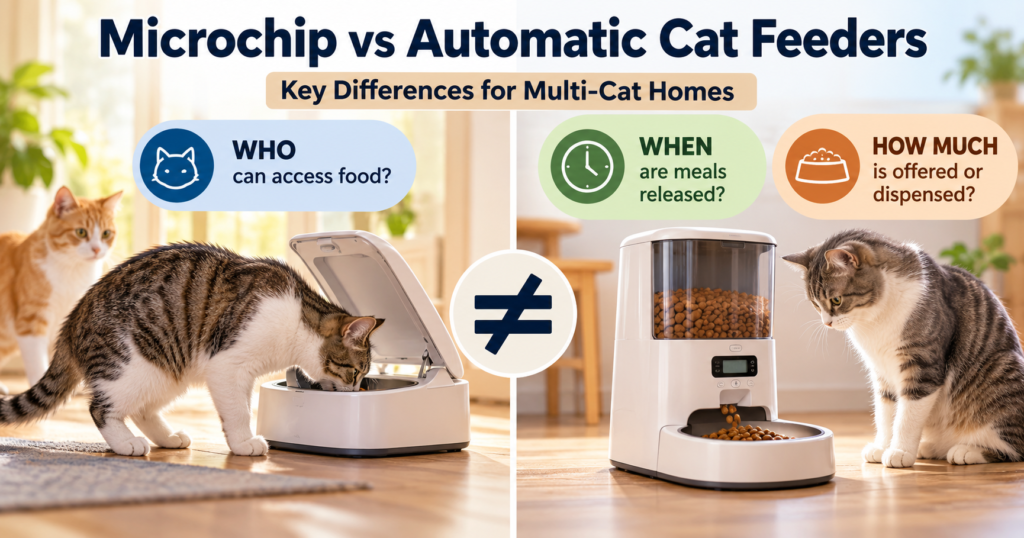
A feeder can release dinner on time and still leave it available to the wrong cat. Another can protect one cat’s bowl while leaving you responsible for filling it. If your household has food stealing, a grazer and a need for scheduled meals, those are three related problems—but they do not all require the same feature.
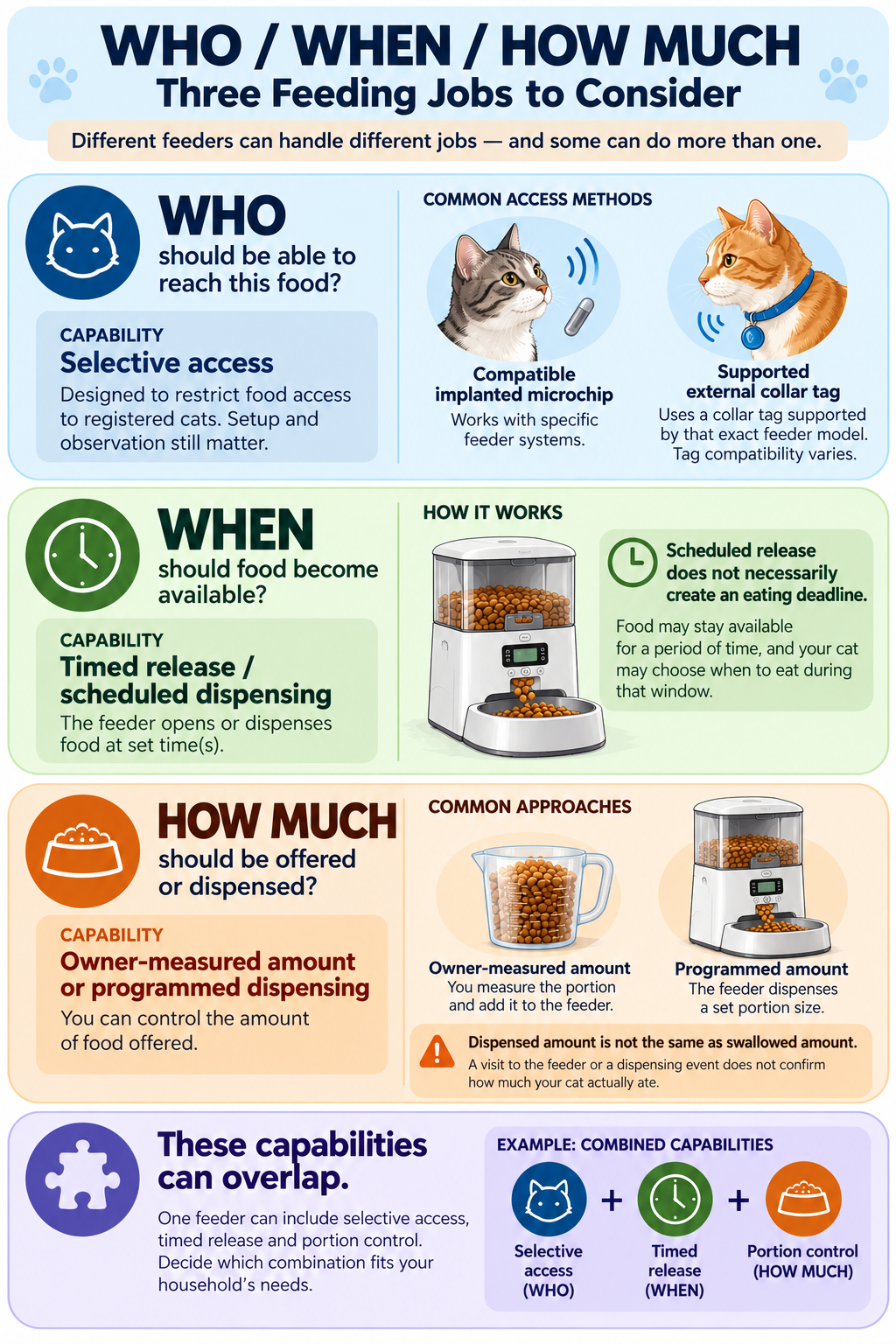
The useful distinction is between who can reach the food, when it becomes available, and how much is offered or dispensed. Identify those needs before choosing a feeder category.
Start with your household’s feeding problem
Write down the job you want the feeder to do. “Keep another cat out of this bowl” is different from “release a meal while I’m away.” “Offer a measured portion” is different again from “tell me how much this particular cat swallowed.”
You may need one capability, or a combination. You may also be able to manage the problem with separate feeding spaces or supervised meals. Equipment is useful when a specific feature fills a gap in your setup.
Microchip vs automatic cat feeders: access and dispensing are different
In a microchip vs automatic cat feeder comparison, identity restriction and automatic food dispensing are independent capabilities. A motorized lid does not necessarily dispense food, and a timed dispenser does not necessarily identify the cat at its bowl.
WHO can access the food?
Selective access means the feeder is designed to admit an authorized identity. Depending on the model, that identity comes from an implanted microchip or an external collar tag. The practical question is whether the intended cat can reach her food while another cat’s access is restricted.
In our home, Qitiao tries to eat Erbing’s food after finishing her own. Erbing typically steps back, watches Qitiao, moves away and waits, then returns after Qitiao leaves. That makes access—not simply putting food out—the relevant equipment question for this situation.
WHEN does food become available—and remain available?
A timer can release food at a chosen time. It does not necessarily set an eating deadline: food released at 8:00 may still be accessible at 8:15. Check what happens to leftovers, rather than assuming a scheduled release also closes access afterward.
Erbing eats small amounts across several meals. After a short separation, leftover food may still be accessible to Qitiao when the space is reopened. For a grazer, protecting return visits can be a different requirement from releasing a fresh meal on a timer.
HOW MUCH is offered or dispensed?
An owner-filled bowl contains the amount you put into it. A dispensing feeder releases a programmed portion. Neither tells you, by itself, how much the intended cat ate.
Dispensed amount ≠ swallowed amount. Food may remain in the bowl or become accessible to another cat. Likewise, a recorded visit or feeding event is not a measured amount swallowed.
When we review feeding footage, we can mainly see how often the cats visited; it is difficult to judge how much they actually consumed each time. For the measurement task, see our guide to monitoring each cat’s food intake. Here, the equipment question is what the device measures—and what it leaves unknown.
How feeder designs combine these capabilities
The four descriptions below form a comparison framework, not four mutually exclusive technologies. The microchip and collar-tag rows describe recognition methods; the hybrid row describes recognition combined with automation. One product can fit more than one row.
Representative examples are based on manufacturer documentation; these named feeders have not been tested by MultiPetLife.
Traditional automatic feeders: timed release and dispensing
A traditional automatic feeder handles timing without identity-restricted food access. A hopper model releases portions into a bowl; a compartment model exposes food you loaded beforehand.
The PetSafe Smart Feed 2nd Generation, PFD00-16828, illustrates the hopper approach. PetSafe documents app-controlled schedules and dry-food dispensing. Its documented bowl-and-conveyor design provides timed food delivery, rather than a chip- or tag-controlled access gate. A schedule therefore does not reserve the released food for one cat. See PetSafe’s exact-model documentation.
Traditional automatic feeders also include timed compartment designs: the manufacturer lists wet/dry compatibility for the Closer Pets C500, whose compartments the owner prefills.
Microchip selective-access feeders: implanted-chip recognition
These feeders recognize a compatible implanted identification chip to control bowl access. Check the exact model and your cat’s chip compatibility; the category name is not a promise that every chip will work.
The SureFeed Microchip Pet Feeder is an owner-filled selective-access example. Sure Petcare documents recognition of an implanted chip or its compatible RFID collar tag, with wet or dry food in the bowl. The lid responds to a registered pet; the owner replaces the food. Automatic lid movement is not timed hopper dispensing. See the SureFeed product information and compatibility checker and owner-filling instructions.
This design points toward protected access to food already offered, rather than automatically releasing a new portion at a chosen time.
RFID collar-tag feeders: external tag recognition
An external RFID tag is worn on a collar. Seeing “RFID” in a product name does not establish support for an implanted microchip. Confirm what the reader accepts: the supplied tag, replacement tags from the same manufacturer, other tags, or implanted chips.
For the PETLIBRO ONE RFID Smart Feeder, PLAF301, the official FAQ specifies a dedicated collar tag—not implanted microchips or other brands’ tags. It pairs with one collar tag, and its recognition system requires the supplied reader mat. This is a collar-tag access system. ONE PLAF301 specifications and compatibility FAQ.
Disclosure: This post contains affiliate links. If you buy through them, MultiPetLife may earn a commission at no extra cost to you.
Another commercially available collar-tag example is the HoneyGuardian RFID Automatic Cat Feeder. Its product listing describes an RFID collar tag that identifies the cat and unlocks the bowl lid. This is a collar-tag access mechanism; do not assume implanted-microchip compatibility from the RFID label. Compare the exact model’s compatibility and setup requirements with your household’s access needs.
Hybrid feeders: identity access plus automatic release/dispensing
A hybrid combines identity-restricted access with automated food delivery. The ONE PLAF301 is also an example of this row: PETLIBRO describes scheduled dispensing alongside tag-controlled access, with dry food only. Its collar recognition and automation are separate features combined in one device.
The manufacturer describes PawsPik’s Automatic Microchip RFID Pet Feeder as combining implanted-chip access with scheduled dispensing, specifying FDX-B ISO 11784/11785 compatibility. This is another hybrid combination; chip compatibility remains model-specific, rather than universal.
Compare the capabilities side by side
Read the rows as overlapping capabilities. Wet-food suitability always needs an exact-model check.
| Feeder type | Controls WHO | Controls WHEN | Controls HOW MUCH | Wet food potential | Useful when you need | Main limitation |
|---|---|---|---|---|---|---|
| Traditional Automatic | No identity restriction in this row | Timed release | Dispensed or owner-prefilled amount | Model-dependent; C500 is a wet-food compartment example | Meals released on a schedule | Released food is not reserved for one cat |
| Microchip Selective Access | Compatible implanted identity; some accept tags too | Opens on recognition; timed release only if also a hybrid | Owner-offered amount in access-only bowls | Model-dependent; SureFeed lists wet/dry | Protected bowl access, including return visits | Access control alone does not dispense portions |
| RFID Collar-Tag Selective Access | Supported external tag | Recognition; timing depends on automation | Owner-filled or dispensed, depending on model | Model-dependent; ONE PLAF301 is dry only | Tag-based protected access | Tag/reader compatibility; implanted-chip support must be checked separately |
| Hybrid / Selective-Access Automatic | Compatible implanted chip or external tag | Automated release plus selective access | Programmed dispensing in the cited hybrids | Model-dependent; no category-wide promise | Both protected access and scheduled portions | Combined features still do not confirm swallowed intake |
Match your household problem to the feature you need
- One cat takes another cat’s food → WHO: Start with identity access. A timer alone addresses release time. Placement, introduction and observation still matter; see our guide to one cat eating another cat’s food for the broader management problem.
- Cats need different foods → WHO: Look for a way to restrict each relevant food station to its intended cat. For prescription or special diets, a feeder is a feeding-management tool; follow your veterinarian’s diet plan. It does not establish that the right amount was eaten or replace veterinary care. Veterinary context on feeding different diets.
- You want scheduled meals → WHEN: Look for timed release. Add selective access only if another cat must be excluded. Choose the routine separately from the hardware; our free feeding vs scheduled meals guide covers that decision.
- You want portion control → HOW MUCH: Decide whether manually measuring the offered food is enough or whether you need automated dispensing. A programmed portion controls food offered, not confirmed consumption by one cat.
- You need protected, scheduled portions → WHO + WHEN + HOW MUCH: Look for a hybrid that combines identity access with timed dispensing of programmed portions.
- You want individual intake information → Check data meaning: Find out what each data field represents. A dispensing log, access event, bowl-weight change and swallowed intake are different observations. Do not choose on the strength of a generic “feeding data” label.
- Your cat grazes → WHO for protected return access: Ask whether she needs protected access when she returns. Scheduled release may be useful too, but it is not the same feature.
- You feed wet food → Check food compatibility first: Read the specific model’s food instructions and handling requirements. Do not infer wet-food compatibility from “microchip,” “RFID” or “automatic.”
What feeders still cannot confirm or guarantee
Selective access needs a workable setup. The SureFeed manual includes gradual introduction and troubleshooting for other pets accessing an open bowl, so an identity-controlled lid should not be treated as a guarantee against every food-stealing attempt. Observe whether the intended cat can use the station and whether another cat can interfere. SureFeed setup and troubleshooting manual.
Connected data also has limits. The PFD00-16828 guide describes an activity log of dispensing events and errors. That is evidence about the feeder’s activity, not proof of which cat swallowed the food. Smart Feed PFD00-16828 guide.
A lid, seal or ice pack is not evidence of refrigeration or a safe all-day wet-food window. FDA advises promptly refrigerating or discarding leftover canned and pouched pet food. Follow the food’s storage instructions and the feeder’s handling directions rather than turning a freshness feature into a safety promise. FDA pet-food storage guidance.
What to check before buying—and when a simpler setup may be enough
Before comparing extras, confirm:
- Identity: Which implanted chips or external tags does this exact model recognize? Does it need a collar, reader mat or other component?
- Food and portions: Does it accept your food type? Do you fill a bowl or compartment, or does it dispense a programmed amount? What do its portion units mean?
- Availability: What happens after release, when food remains, and when the intended cat returns?
- Practical use: Check introduction, cleaning, placement, power, app requirements and the manufacturer’s instructions for handling a malfunction. Keep a way to feed the cats if the device is unavailable.
- Data: Identify what is actually measured before treating a number or notification as individual intake.
A simpler arrangement may already meet your needs: separate feeding spaces, supervised meals, physical separation, feeding stations or a routine adjustment. In our household, two side-by-side bowls did not stop Qitiao from reaching Erbing’s food. That describes our particular access problem; it does not mean multiple bowls never work. For setup methods, see feeding multiple cats separately.
Start with the feeding gap: WHO needs access, WHEN should food become available, and HOW MUCH do you want to offer or dispense? Choose only the capabilities that address that gap. More automation or a higher price does not, by itself, make a feeder a better fit for your household.