How to Stop One Cat From Eating Another Cat’s Food
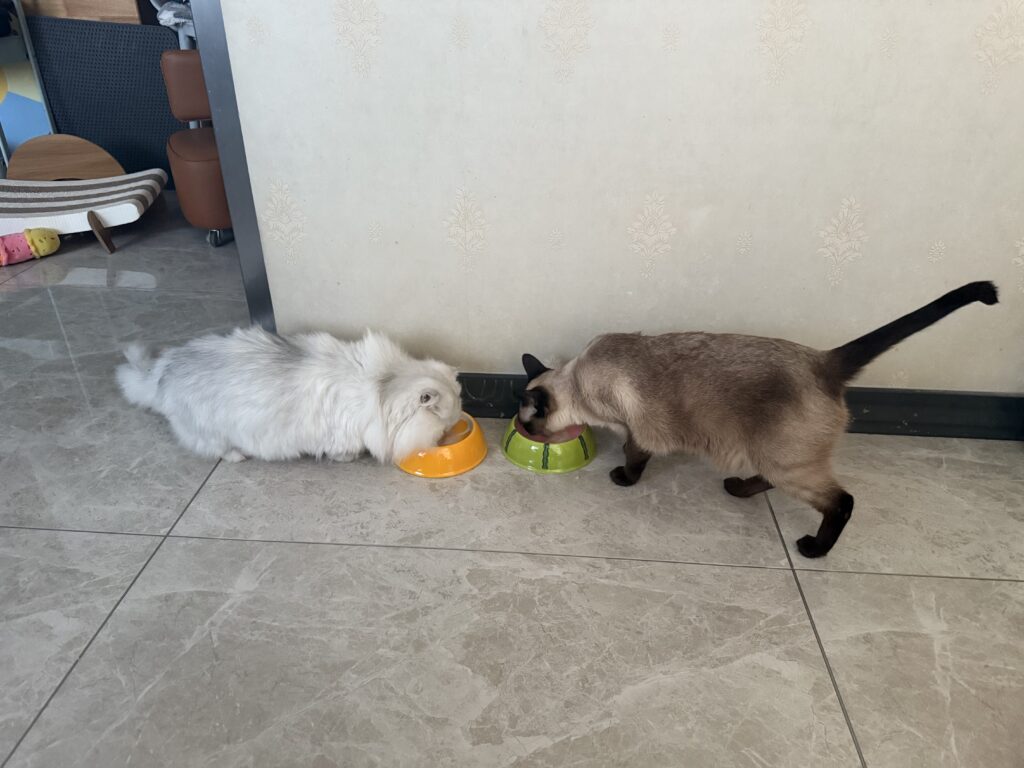
Qitiao would finish her own food and head straight for Erbing’s bowl.
Erbing rarely tried to stop her. She would step back, watch Qitiao eat, then walk away and wait until the bowl was free again.
At first, the solution seemed obvious: give them two bowls.
The problem was, we already had two.
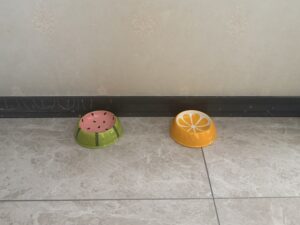
Each cat had her own bowl, both contained the same food, and we placed them side by side. None of that stopped Qitiao from finishing her portion and moving on to Erbing’s.
Over time, we tried feeding them in separate rooms, switching to scheduled meals, and using an automatic feeder. Each approach helped with one part of the problem, but none quite matched the way Erbing likes to eat.
Eventually, we realized we had been asking the wrong question.
It wasn’t just when or where our cats ate. The harder question was:
How could Erbing keep access to food she wanted to come back to later without leaving it equally accessible to Qitiao?
Quick Answer
If one cat keeps eating another cat’s food, start with separate feeding spots and watch what happens after the faster cat finishes.
If both cats finish their meals at roughly the same time, separate rooms or feeding stations may be enough. But if one cat grazes and returns to her food later, you also need to think about what happens between meals.
Depending on the household, that might mean:
- separate feeding areas;
- scheduled meals that suit both cats;
- an automatic feeder if timing or dispensing is the main problem; or
- a selective-access feeder if the real problem is which cat can reach the food.
An ordinary automatic feeder should not be assumed to protect one cat’s food from another.
Separate feeding guidance · Feeding routines
At a Glance: What We Tried
| Setup | What happened in our home | The remaining limitation |
|---|---|---|
| Two assigned bowls side by side | Qitiao finished hers and moved to Erbing’s. | Assigning separate bowls did not create separate access. |
| Separate-room feeding | Erbing could eat while Qitiao was kept out. | Qitiao scratched at the door, and leftovers became accessible again after she was released. |
| Scheduled meals | We tried morning and evening meals, sometimes adding another before bed. | The routine became harder to manage and did not fit Erbing’s grazing style. |
| Ordinary automatic feeder | It reduced manual refilling and kept dry food available. | It controlled food supply, not which cat could eat it. |
| Our current shared bowl | We refill it manually, and food stealing has become much less noticeable. | We cannot accurately measure or separately control each cat’s daily intake. |
| Microchip feeder | Researched, not tested by us. Some models restrict access to registered pets. | Training and real-world access still need consideration. We do not have a household result. |
Our Two Cats Have Very Different Eating Styles
Erbing, our former stray, joined our home in October 2022. A veterinarian estimated from her teeth that she was about a year old at the time.
She has always been a slow eater. Rather than finishing everything in front of her, she prefers to eat a little, leave, and come back later.
Qitiao arrived in July 2023 at around four months old. For roughly her first two months with us, we fed her separately and continued the cattery’s routine of kitten food softened with goat milk.
At around six months old, she moved onto the same dry food as Erbing.
That was when their different eating styles became impossible to miss.
We would put their assigned bowls side by side.
Qitiao would finish first, then move straight over to Erbing’s food.
Erbing generally yielded rather than defending her bowl. We have not seen obvious aggression from her when Qitiao approaches. She typically steps back, watches for a moment, moves away, and waits.
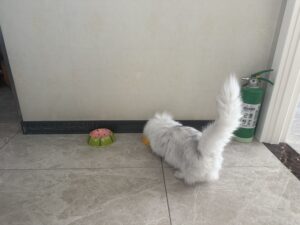
Even now, adding fresh food can trigger the same sequence: Qitiao eats first, Erbing waits nearby, and Erbing returns once Qitiao leaves.
Erbing and Qitiao eat at very different speeds. Qitiao usually finishes first, while Erbing prefers to eat a little at a time.
Why One Cat May Eat Another Cat’s Food
There isn’t one explanation that fits every multi-cat household.
Sometimes the most useful place to start is simply by watching what happens around the bowls:
- Which cat finishes first?
- Does one cat leave food and return later?
- Does the slower cat move away when the other approaches?
- Can both cats reach both bowls?
- Does the problem happen only during meals, or whenever food is available?
In our home, the pattern was fairly straightforward: Qitiao finished quickly, Erbing left food behind, and nothing prevented Qitiao from reaching it.
That does not mean we need to label either cat as “dominant,” “anxious,” or anything else.
More generally, veterinary feeding guidance notes that shared feeding environments can involve tension, and some cats may rush meals around other cats. Leaving food freely available can also make it harder to monitor individual intake and may allow some cats to overeat.
Those are possibilities to consider—not diagnoses we have made about Erbing or Qitiao.
Feline feeding guidance · Free-feeding considerations
Our cats normally eat the same food, and neither normally requires a prescription or special diet. We also have not observed significant weight loss or another health problem that we attribute to the food stealing.
For us, this has mainly been a practical problem: two cats with different eating styles sharing access to the same food.
What We Tried in Our Home
1. Two Assigned Bowls Side by Side
Our first setup was simple: one bowl for Erbing and one for Qitiao.
Both bowls contained the same food, and each cat had an assigned bowl.
But assigning a bowl did not mean Qitiao stayed with it.
Once she finished her portion, she could simply move sideways and start eating from Erbing’s bowl. Erbing rarely challenged her and would usually step away instead.
Our original setup used two assigned bowls side by side. The second bowl gave each cat a place to eat, but it did not prevent Qitiao from moving between them.
The lesson for us was simple:
More bowls do not necessarily mean protected access.
A true separate-feeding setup can be different. Distance between feeding stations or a visual barrier may help cats that are uncomfortable eating close together. That is not the same arrangement as the side-by-side bowls we tried.
2. Feeding Qitiao in a Separate Room
Next, we tried physically separating the cats.
We put Qitiao in another room so Erbing could eat without Qitiao reaching her bowl.
That solved the immediate access problem—but only while the door was closed.
Qitiao would keep scratching at the door until we opened it. Erbing, meanwhile, still ate slowly. She frequently looked toward the door and usually ate only part of her food.
We did not use a fixed separation time. Once Erbing stopped eating, we generally let Qitiao back out.
And that brought us back to the original problem.
Erbing had finished eating for the moment, but she had not necessarily finished the food. Once Qitiao was back in the shared space, the leftovers were accessible again.
Separate-room feeding may work well for cats that eat their meals and finish. In our case, it protected Erbing’s food during the initial meal but did not account for the food she wanted to return to later.
3. Scheduled Meals Twice a Day
We also tried scheduled feeding.
Our routine was roughly:
- around 7:00 a.m., before leaving for work;
- around 6:00 p.m., after coming home.
In practice, it became harder than it sounded.
Morning feeding meant waiting while Erbing ate slowly, letting Qitiao out, and then clearing the bowls before we left.
Erbing often ate only a small amount.
By the time we returned home, she would sometimes vocalize for food. She was usually the one asking for food between scheduled meals.
Dinner did not completely fix the pattern either. Erbing still preferred to eat a little at a time, which sometimes meant giving her another meal before bed.
Eventually, we stopped.
Scheduled feeding was not inherently a bad idea; it simply did not fit Erbing’s eating style or our daily routine very well. It added more work without adequately solving the access problem we were trying to fix.
Meal frequency can depend on a cat’s age, health and individual needs, so another household may have a very different experience.
4. An Ordinary Automatic Feeder
At one point, we also used a CATLINK automatic feeder with dry food.
We used it for less than a year.
In the app, we created an active dispensing window from roughly 7:00 a.m. to 11:30 p.m. We disabled overnight dispensing because the operating noise could disturb our sleep.
During that window, we set the feeder to dispense about 20 g when the food level dropped below roughly 10 g.
Those were settings we chose ourselves—not manufacturer defaults.
For what we wanted at the time, the feeder did have a clear benefit: it reduced manual refilling and helped keep dry food available during the day.
But it still could not answer the question that mattered most to us:
Which cat was eating the food?
The feeder managed food supply. It did not reserve Erbing’s food for Erbing.
We also found cleaning inconvenient. The hopper was large and somewhat heavy, and the lower dispensing area had grooves and irregular surfaces that were awkward to clean. The small outlet was difficult to reach by hand, while washing around electrical components in the base required extra care.
If we wiped the area instead of washing it, we sometimes wondered whether we had cleaned it thoroughly enough.
We also had concerns about moisture and freshness, although we did not observe confirmed spoilage or moisture damage.
We no longer use this feeder, and we have not confirmed its exact model. For that reason, this is our experience with our feeding routine, not a CATLINK product review or standardized product test.
The experience did, however, teach us something useful:
Automatic dispensing and individual access are two different functions.
If your main problem is refilling food or feeding at specific times, an automatic dispenser may be worth researching.
If your main problem is one cat eating another cat’s food, you need to look separately at who can access the food.
What We Eventually Realized: Our Problem Was Access
Looking back, we had been trying to solve several different feeding problems as though they were the same thing.
Two bowls changed where the cats ate.
A separate room temporarily changed who could reach the bowl during a meal.
Scheduled feeding changed when food was offered.
Our automatic feeder changed when and how food was dispensed.
But none of those arrangements reserved Erbing’s leftover food for her once Qitiao could reach it.
That distinction is useful when comparing feeding solutions:
| The problem | The function to look for |
|---|---|
| Cats need more space while eating | Location / separation |
| Food needs to appear at certain times | Scheduling |
| Specific amounts need to be dispensed | Portion dispensing |
| One pet should be able to reach food while another cannot | Selective access |
A product described as “automatic” does not necessarily provide all of these functions. Always check what the specific feeder actually does.
SureFeed functionality · SureFeed user manual
Qitiao moving toward Erbing’s food after finishing her own—the access problem we were trying to solve.
What Works Better for Us Now
After trying more structured approaches, we eventually went back to something much simpler:
one shared bowl that we refill by hand.
When the bowl is empty, we add food. In general, food remains available so either cat can eat when she is hungry.
For our household, the stealing pattern has become much less noticeable.
There is less of a single feeding event in which Qitiao finishes first and immediately moves on to a limited amount of food left for Erbing.
But this setup comes with an important tradeoff.
We cannot accurately tell how much Erbing eats in a day versus how much Qitiao eats. We also cannot independently control their daily intake.
For a practical way to record what you can observe and measure, see our guide to monitoring each cat’s food intake.
So this is not our recommendation that every multi-cat household should use one shared bowl.
It is simply the setup that currently fits our cats and routine better.
It made day-to-day feeding easier for us, while making individual intake monitoring harder.
When a Microchip Feeder May Be Worth Researching
Research-based section: We have not tested a microchip or RFID feeder in our home.
Microchip feeders became interesting to us for one specific reason: selective access addresses the part of our setup that we still cannot control.
In other words:
Could Erbing have food available when she wants to return to it without leaving that same food open to Qitiao?
For example, Sure Petcare describes its SureFeed Microchip Pet Feeder as opening for a registered pet’s microchip or RFID collar tag.
A person still fills the bowl. The selective lid controls access.
That is different from an ordinary automatic feeder whose primary job is dispensing food at certain times or amounts.
A selective-access feeder may therefore be worth researching when:
- one cat grazes while another steals leftovers;
- one pet needs access to food for longer periods;
- cats need to eat different diets; or
- keeping the cats physically separated for every meal is impractical.
On the other hand, if your cats already eat comfortably in separate spaces and finish their meals, you may not need a more complicated device.
There are limitations to consider, too.
The SureFeed manual describes a gradual training process and notes that other pets may be able to reach the food during training. Closing-delay settings can also affect what happens after the registered pet moves away.
So we would not assume that buying a microchip feeder automatically solves food stealing.
We have not tested one with Erbing and Qitiao yet, and we do not know how either cat would respond to it.
Official SureFeed product documentation · SureFeed user manual
To understand the difference before considering a purchase:
How Microchip Feeders Differ From Automatic Feeders
For our researched shortlist:
Best Microchip Feeders for Multiple Cats
Which Feeding Setup Fits Your Household?
Before buying another bowl or feeder, identify the problem you are actually trying to solve.
If the problem is timing:
Look at feeding schedules or programmable feeders that can dispense food when you are unavailable.
If the problem is portioning:
Check how much a feeder dispenses—and whether you can tell which cat actually eats that portion.
If the problem is location:
Try separate feeding stations, more distance between bowls, or a visual barrier.
If the problem is individual access:
Consider how one cat’s food can remain available without being equally accessible to the other cat. Selective-access feeders are one option to research.
If your cats need different diets:
Talk with your veterinarian about each cat’s nutritional needs first, then choose a setup that keeps the appropriate food accessible to the intended cat.
For a practical plan that covers mealtime separation and later return access, see our guide to feeding multiple cats separately.
When to Talk to Your Vet
Food stealing is not always just a feeding-setup issue.
If your cat suddenly becomes much hungrier than usual, loses weight, starts drinking or urinating noticeably more, or shows another significant change in eating behavior, contact your veterinarian.
If a cat stops eating, seek veterinary advice promptly rather than assuming the problem is simply competition around the food bowl.
Appetite and weight changes · Drinking and urination changes · A cat not eating
Our Takeaway
The biggest lesson from our experience was not that one feeding method is better than all the others.
It was that we needed to stop expecting Erbing to eat on Qitiao’s timetable.
Two bowls, separate rooms, scheduled meals and an automatic feeder each addressed a different part of feeding. None perfectly matched a cat who likes to leave food and come back later while living with another cat who is happy to finish what is available.
For now, keeping food generally available in one shared bowl works better for our household. Food stealing has become much less noticeable, but we have traded that convenience for less control over individual intake.
That is a tradeoff we are comfortable with for now—not a perfect solution and not necessarily the right one for every household.
Before buying another feeder, we would ask one question first:
What are we actually trying to control—where the cats eat, when food appears, how much is dispensed, or which cat can access it?
Knowing the answer makes it much easier to decide what is worth trying next.
FAQ
Will two bowls stop one cat from eating another cat’s food?
Not necessarily.
We gave Erbing and Qitiao separate assigned bowls, but because the bowls were side by side, Qitiao could simply finish her own food and move to Erbing’s.
More distance, separate feeding stations, or a visual barrier may be worth trying. But in our home, adding a second bowl by itself did not protect Erbing’s food.
Will an automatic feeder stop food stealing?
Not necessarily.
Our ordinary CATLINK feeder helped keep dry food available and reduced manual refilling, but it did not control which cat could eat the food.
When comparing feeders, check automatic dispensing and selective access as separate features.
What if one cat grazes throughout the day?
Think beyond the first meal.
A grazer may eat a little, leave, and return later. That means a feeding arrangement that works for 15 or 20 minutes may still leave the food unprotected afterward.
That was the main difficulty with Erbing.
If you are changing how much or how often your cat eats, discuss an appropriate feeding plan with your veterinarian.
Can two cats share an automatic feeder?
They can potentially both eat from the same open feeding area, depending on the feeder, but that does not mean you can accurately measure or control how much each cat consumes.
That was one of the limitations in our household.
If individual portions matter, check exactly how the feeder identifies pets—or whether it identifies them at all—rather than assuming one automatic feeder can manage two cats separately.
Will a microchip feeder stop another cat from eating the food?
Some microchip feeders are designed to restrict access to registered pets, but that does not guarantee another cat will never reach the food.
Training, feeder design and closing behavior can all matter.
We have not tested a microchip feeder with Erbing and Qitiao, so we cannot say whether it would solve our particular setup.