How to Feed Cats Different Diets in the Same Home

To feed cats different diets in the same home, start with the food chosen for each cat and control who can reach it. Then decide what happens when one cat finishes first or leaves food, and when the cats can share the space again.
Putting the right food in separate bowls gets the meal started. Keeping unfinished food with the cat it belongs to—and making sure the next person feeding the cats knows what remains—is the part that needs follow-through.
Quick answer: Offer each cat the food and portion in their existing plan, watch who reaches it, and decide what to do with leftovers before letting the cats back together. If a cat needs another protected chance to eat later, make sure someone knows when and how to provide it. Record what you saw without assuming an exact amount was eaten. Equipment is an option when a specific access or timing problem remains.
Start with a food plan for each cat
This guide is about carrying out individual food plans—not choosing a therapeutic diet or deciding how much a cat should eat.
The reason for separate foods might be a life-stage difference, an existing weight-management plan, or a veterinarian-directed diet. VCA's guidance on feeding multiple pets discusses individual calorie needs and life-stage differences; use the appropriate plan for each cat as your starting point.
A short note beside the food supplies can make that plan easier to follow:
- Food: Which food belongs to which cat?
- Meals: What portion and schedule should each cat follow?
- Access: Who can reach the food while it is out?
- Leftovers: What should happen to them, including another chance to eat if needed?
- Other people feeding the cats: What do they need to know about the meal and anything you could not confirm?
If medication is involved, whether a particular medicine can be given with food should follow your veterinarian's guidance or that medicine's specific instructions. VCA's medication guidance emphasizes checking the prescription instructions and dietary restrictions.
Build the session around access, portions and leftovers
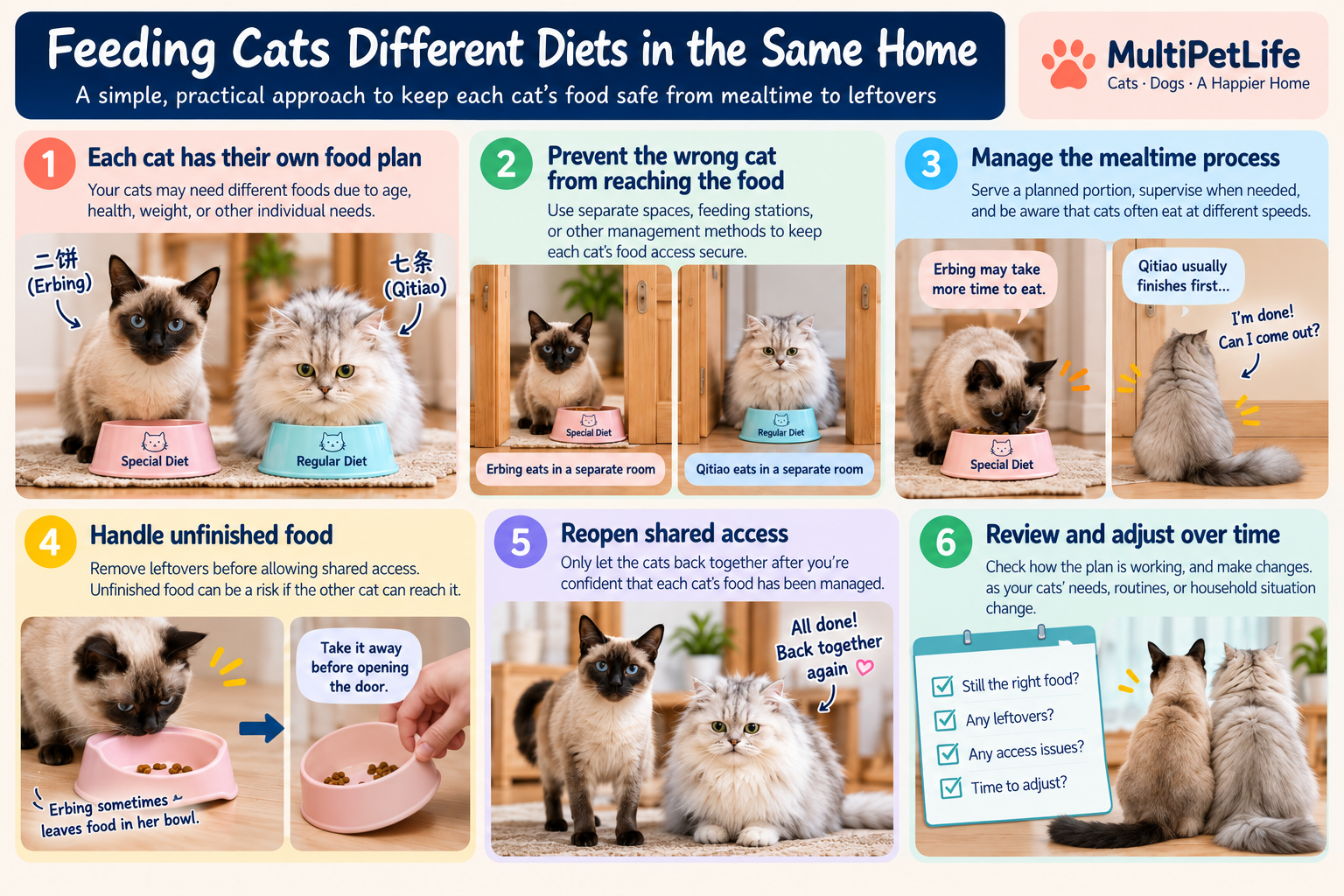
The steps are: Assign → Protect access → Offer planned portion → Observe/check uncertainty → Secure leftovers → Reopen access → Review. This is a household planning framework, not a veterinary protocol.
Assign the food and the intended cat
Keep it clear whose food you are preparing and serving. A label on the food container or a short note can help someone else feed the cats without relying on bowl color or memory.
Be just as specific about leftovers. A useful note says which cat the food belongs to and what to do with it—not simply “there is food left.”
Protect access without rebuilding your whole routine
Use a setup that lets you control which cat can reach each food. If you need the basic setup options, our guide to feeding multiple cats separately covers feeding spaces and physical separation.
Also decide what happens after the food is served. Will it stay available to the intended cat, be cleared when the meal ends, or need to be offered again later with protected access? Settle that before the faster cat is ready to leave.
Offer the planned portion and supervise what needs supervision
Use the portion in each cat's existing plan. Do not assume that different foods should be offered in matching amounts. Ask your veterinary team about individual feeding amounts when those have not been established.
During a supervised meal, watch which cat reaches which bowl and what happens when one finishes. Leave time to watch and wait. If someone needs to stay present, the meal is not an unattended task.
There is no single meal frequency for every cat. Cornell's feeding guidance explains that feeding frequency and amounts depend on factors including age, health and preferences.
Check completion—and record what you cannot confirm
Write down what you offered and what you actually saw. For example, “I watched her eat, but some food remained” tells the next person more than an assumed “full portion eaten.”
An empty bowl, a visit to a feeder, or a dispensing event does not by itself establish an exact swallowed amount. If you need a more detailed record, see our guide to monitoring each cat's food intake.
If medication-containing food is unfinished, ask your veterinarian how to proceed. These observations cannot tell you the dose received.
Secure leftovers before reopening shared access
Before letting the cats back together, check whose food remains and who will be able to reach it next. Clearing the bowl and keeping it available for a protected return visit are different choices. The faster cat finishing does not tell you what to do with the food that remains.
Here are the questions to answer before reopening the space:
| What happens | What to check before the cats share the space again |
|---|---|
| One cat finishes while another is still eating | Who will look after the finished cat while the other eats? |
| Food remains in a cat's bowl | What should happen to that food, and who could reach it if it stays out? |
| A cat may need another chance to eat later | Who will offer the food later, and how will access be protected? |
| You did not watch the whole meal | What did you see, and what is still uncertain? |
| Someone else takes over feeding | Do they know what was offered, what remains and what still needs doing? |
For ordinary unused canned or pouched food, the FDA advises prompt refrigeration or disposal. That guidance does not establish a safe time in a feeder or a rule for saving medication-containing leftovers; medication-specific handling needs its own instructions.
Let the cats share the space again once you have dealt with the remaining food according to its instructions. A cat does not have to finish on demand; you need to decide what happens to the food before another cat can reach it.
Plan for the cat who finishes first—and the cat who comes back later
During a temporary medication-based feeding situation in our home, Erbing had food intended specifically for her. We fed her and Qitiao in different rooms, using separate bowls, and watched them eat.
Qitiao usually finished first and often kept scratching the door while waiting to come out. We waited until Erbing finished eating before letting Qitiao out, and removed the bowls after the session. Erbing normally left food in her bowl, so Qitiao finishing did not mean we were finished with the meal.
Two separate rooms still left us with watching, waiting and clearing up. This was a temporary arrangement, not evidence of a long-term different-diet system or a treatment outcome.
When one cat is ready to leave, check what is happening with the other cat's food before opening access. If that cat needs to eat again later, agree who will offer the food and keep access protected. Agree on this before the meal, so the later feeding does not depend on someone noticing the bowl.
Separate a temporary supervised arrangement from an ongoing system
A temporary arrangement may depend on someone staying nearby. For everyday feeding, work out who can be there, what happens to unfinished food, and what another person needs to know to take over.
A short note can cover four things:
- What you served: Which cat, which food and the planned portion.
- What you saw: What happened while you were watching.
- What remains: Any food left and what you did with it.
- Who feeds next: Who will offer food again or check access.
These are suggested notes, not a system we have tested at home. Keep them brief enough to use during an ordinary meal.
If a meal needs supervision and nobody can be there, a written note alone will not fill that gap. Work out what still needs someone: watching access, serving food at the needed time, checking leftovers or following a professional instruction.
When a cat's food changes, update the label and notes together. The next person feeding the cats should not have to guess whether an old instruction still applies.
Decide whether equipment fills a real management gap
Describe the gap before considering a device:
- Food is available, but the wrong cat can reach it: The question is identity-based access.
- The intended food needs to become available at a planned time: The question is timed release or dispensing.
- Both tasks are needed: Check whether a particular design combines the required capabilities.
A timer does not establish which cat eats the released food. Identity-based access does not necessarily provide scheduled dispensing. Our comparison of selective access and automatic dispensing explains those differences and the model-specific checks involved, including compatible implanted microchips versus supported external collar tags.
This equipment discussion is based on research, not our hands-on feeder testing. A device may address an access or timing gap; it cannot confirm from that alone how much was swallowed or what medication was received. If a supervised routine already covers the tasks you need, additional equipment may not be necessary.
Review the plan when food, appetite or household arrangements change
Revisit the routine when a cat's food changes, part of the routine keeps getting missed, or a different person will feed the cats. Appetite or health concerns belong with your veterinarian rather than being interpreted through the checklist alone.
Keep four questions in view: Whose food is this? Who can reach it? What happens if it is unfinished? Who feeds next?
The meal is not finished simply because one cat is ready to leave. Take care of the remaining food and make sure the next person knows what still needs doing before the cats share the space again. Those details matter whether you use ordinary bowls, supervision or equipment that fits a particular need.